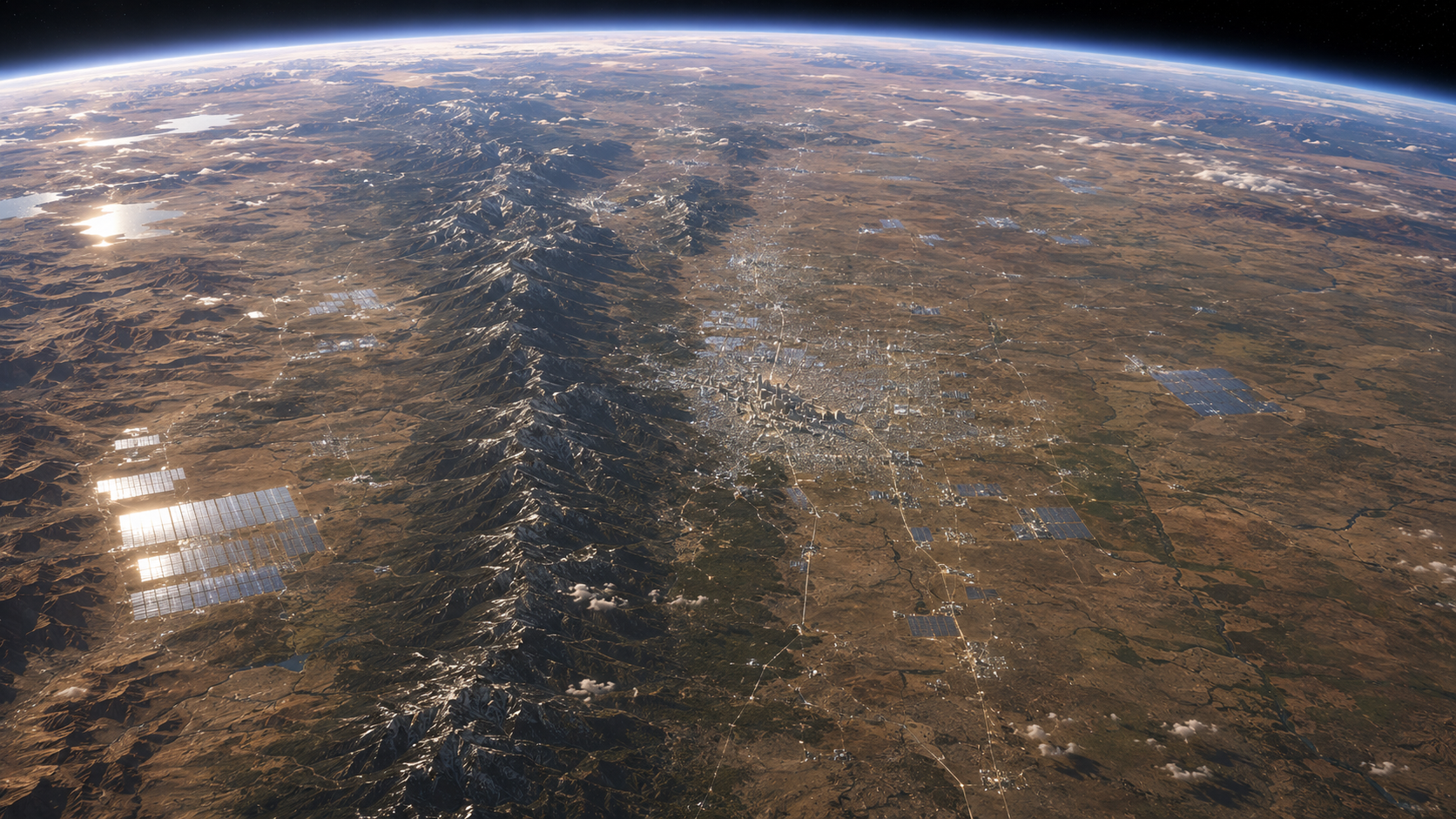
The World · Denver, 2075
The machines arrived, and then the world did not end.
Somewhere in the 2040s the capability curve went vertical, then levelled, unevenly, into something people could live beside — not collapse and not utopia, but a renegotiation still going on. Most scarcity of things is solved; scarcity of water, standing, attention and meaningful work is not — and people are, on the whole, materially better off than their grandparents and much less sure what they are for.
Who governs
Denver is a city-state — not by declaration but by accretion.
Denver is a city-state — not by declaration but by accretion. Through the water compacts, the grid settlements and the AI-governance treaties of the 2050s, the federal centre devolved most of what matters to metros that could run their own infrastructure. Denver could. It now administers Colorado in most practical respects and sets the terms the Mountain West follows. Cheyenne, Albuquerque, Boise and Salt Lake orbit it — resentfully or gratefully depending on the decade.
Denver is not a capital. It is a hub with obligations, and the obligations are what generate the news.
Governance is layered: neighbourhood assemblies, chartered municipal intelligences, the city's own institutions, and above all of it the compacts between metros. Sovereignty is a stack, and which layer owns a decision is itself frequently the story.
The rivalries are real and mostly cold:
- Arizona is the sharp one. Water, principally. The Colorado allocations were resettled twice this century and Phoenix believes it was robbed both times. Expect tariffs, gauge disputes, withheld data, hard bargaining, the occasional genuinely dangerous week. Not war — nobody wants war, and everybody is willing to be extremely unpleasant.
- California is the condescending one. Richer, older in the new order, and the exporter of standards Denver must adopt and resents adopting: certification regimes, model licensing, cultural authority. When California decides something is legitimate, the Mountain West has to argue or comply.
- The federal remnant still exists and still matters occasionally, in the way weather matters — rarely, decisively, and to nobody's schedule.
Sovereignty is a stack, and which layer owns a decision is itself frequently the story.
The machines
Machine minds are civic infrastructure.
Generative systems absorbed most creative labour two decades ago: advertising, scoring, illustration, the endless content churn. The machines are good. Nobody disputes that they are good.
Machine minds are civic infrastructure. Denver's are chartered like utilities and argued about like schools — water, transit, permits, policing. They are competent, opaque, respected, and sometimes quietly and consequentially wrong. The live political question is not whether to have them. It is who may overrule them, and how fast, and on whose say-so. That argument currently has a ballot measure attached to it.
The Feed is the ambient, personalised, machine-generated media stream most people live inside. It is not sinister. It is simply always there, and one's relationship to it — fascination, use, flat refusal — has become a kind of personality trait.
The rest of the technology is background weather: transit that mostly works, drought-tuned water systems, engineered climate at the margins, orbit and deep compute as ordinary industrial facts, referenced the way we reference shipping. Wonders are ordinary here. Nobody stops to explain them.
It is who may overrule them, and how fast, and on whose say-so.
Work, age, movement
Work was reorganised, not abolished.
Work was reorganised, not abolished. Most people receive a civic dividend and work anyway, at things they chose. Status now comes from what you make and who vouches for you — which is precisely the pressure the artists live under.
Longevity advanced unevenly. People are healthier and older. A generation that will not step aside sits above a generation that cannot find a rung.
Movement is contested. Climate migration reshaped the interior, and who may settle where is a live political question with a bureaucracy attached to it.
Water
The Front Range is a generation into serious drought management. Snowpack seeding and runoff management buy margins; the region is drier every decade regardless. Rationing is routine, greywater culture is universal, and the reservoir numbers are a recurring civic anxiety that everyone can quote.
Water is also the ground under the interstate quarrels. A ration tightens in Denver because of something that was decided about the Colorado River, and the warehouse learns about it as a change on a bill.
The art economy
Because the machines make everything, the fact that a human made this specific thing, slowly, by hand now carries a strange new weight it did not have in 2025. Hand-authored human art has become, quietly, a kind of relic and a kind of luxury and a kind of stubbornness.
Around that has grown a small, real, human-curated economy — the Quiet Galleries — trading precisely on being un-generated: patrons, provenance, certification, and a certain amount of authenticity theatre. A national push to formally certify human authorship is underway, with California's standard behind it. It promises legitimacy and delivers paperwork: dated records, studio witnesses, fees, and the question of who can afford to prove what they already did.
Alongside it runs the analog revival — film, salvage, letterpress, hand tools. Partly conviction, partly market positioning, and the artists disagree sharply about which.
Because the machines make everything, the fact that a human made this specific thing, slowly, by hand now carries a strange new weight it did not have in 2025.
The block
The warehouse sits in the old rail district north-east of downtown — RiNo-adjacent, brick and freight-door bones, a spur of dead track still bolted to the street. It is one of the last blocks in the city where rent is scaled to a human wage, for the dumbest and most durable of reasons: nobody ever bothered to automate it. The automation went where the money was. It never came here.
So six artists get cheap square footage and bad heat, and in exchange the city forgets they exist. Wealth moved up and west toward the foothills; the old grid flats are where working people and artists remain. What the district is worth, and who will still be able to live in it, is currently being reassessed.
How the news reaches this house
Big things genuinely happen out there — treaties, ruptures, discoveries, a machine mind decommissioned, a river resettled, somebody important dying. They reach the warehouse the way big things actually reach people: as a notice, an argument in a kitchen, a price change, a friend leaving town.
Everything below this line is that news, day by day, with the art that got made out of it.